This is part three of a multi-part series. If you want to read this series in order, you can start with Part One: Demystifying the Algorithm and Part Two: From Keywords to Search Terms or continue with Part Four: The Long and Short (Tails) of Broad Match.
This article assumes a basic understanding of the machine learning algorithm hiding behind the Google Search curtain, the difference between a keyword and a search term, and how Exact Matching with Google works.
Phrase Match
Phrase Match is the middle ground option for Google Search, sitting in between Exact (which we've already covered and is really more like exact…ish) and Broad (which, spoiler alert, we'll be tackling after Phrase!).
If Exact Match is "tight," Phrase Match is where things start to loosen up. It's the middle ground between precision and chaos — or, as Google describes it, "moderate" matching. In this part, we'll look at what that actually means for your campaigns and why "includes the meaning" can find you matching with search terms you never planned to advertise on.
As a quick refresher, here is how Google defines their three match types:
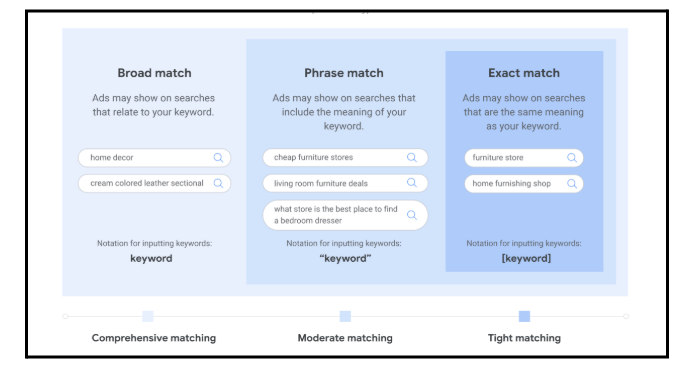
The difference between Google's explanation of Exact and Phrase match is very subtle — for Exact, ads may show on searches that "are the same meaning", while for Phrase, the stipulation is that the search "include(s) the meaning". Google further describes Exact matching as "tight" and Phrase as "moderate", which hints at how they ultimately differentiate between the two.
The real question is what the difference between "same meaning" and "includes the meaning" looks like in practice. For this, we can turn to the same dataset we began investigating in Part Two and examine search term matches to the keyword "online MBA programs" at the Phrase Match level.
With Phrase Match, our client's keyword was ultimately matched to 136 different search terms — almost 4x more than the 35 matches at the Exact level. Of these:
- Almost 90% (122) contained all three words from the keyword — "online", "MBA" and "program(s)" — somewhere in the search term
- 13 searches did not include "online" — every single one referenced an MBA program at a specific (competitor) school.
- 14 searches did not include "program" — all 13 that did not include "online", and then "is an online mba worth it reddit?"
- Only one search term did not include the MBA acronym — obs masters, which refers to an Online Business School, an online business school based in Spain that offers Masters and MBA degrees.
In other words, while the volume of matches exploded, the types of variation fell into nine clear thematic categories:
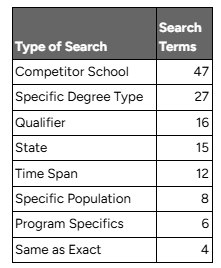
Competitor Schools
Just over one third of all phrase matched searches included the name of a competitor school — 36 different institutions in total. Larger schools such as Harvard and Arizona State appeared more than once and the list spanned not only the entire US, but even included three international schools as well (Brazil's Institute of Management, ENEB — the European Business School of Barcelona, and the previously mentioned OBS, also in Spain). This illustrates how Phrase Match can quickly expand into territory advertisers may not have intended — in this case, pulling in competitor-branded searches from across the map.
The problem here is that this traffic rarely benefits you — a fact clearly demonstrated by our performance data. The 47 competitor search terms our keyword matched to ultimately generated 71 impressions and not a single click.
On one hand, no clicks means no wasted spend. But when it comes to Search, impressions without engagement aren't harmless — they drag down your click-through rate, which in turn lowers Quality Scores and ultimately overall campaign performance. Matching to competitor-branded search terms also increases the likelihood Google will classify both your ad and landing page as less relevant. This can depress your ad rank and inflate your CPCs — meaning you're spending more to compete for clicks from auctions you hadn't even wanted to be involved in.
Phrase Match aligning with competitor search terms also means that the overall proportion of your budget being consumed by competitor prospecting can easily outpace what you expected or intended — even if you're not explicitly running competitor campaigns.
And while Google may refine its future matches based on poor engagement, it also penalizes campaigns that consistently underperform. In short: showing up for competitor searches you never intended to bid on can quietly erode your entire account's efficiency.
While competitor searches highlight how Phrase Match can drag you into auctions you didn't want, degree-type matches reveal a different type of challenge: the nuance between a (general) MBA program and an MBA program with a specific focus. Let's talk about the risk of paying for traffic that's adjacent to — but not quite aligned with — your actual program.
Specific Degree Types
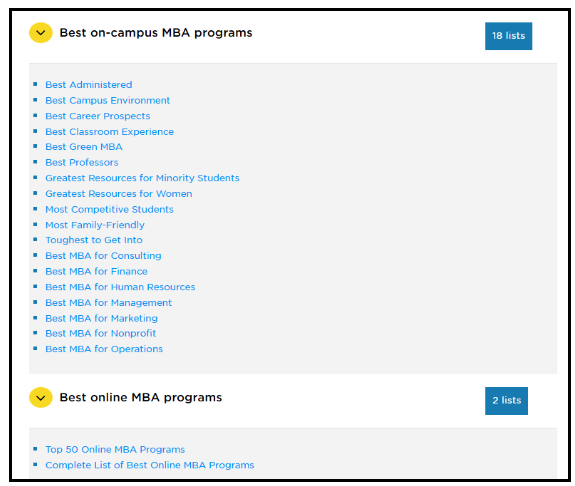
If there's one thing higher ed is great at, it's diversification — and MBA programs in particular offer robust examples of this in action. If you've decided you want to pursue an MBA, that's only the first step in your decision-making process because you're also going to need to figure out what kind of MBA you're interested in. There are so many possibilities that for 2025, The Princeton Review has actually produced 20 "best-of" lists for MBA programs alone.
Ultimately, searches in our dataset related to 10 different types of programs, which we further segmented into those that related to an MBA in a specific programmatic area (six total) and qualifiers that relate to a type of MBA (four total):
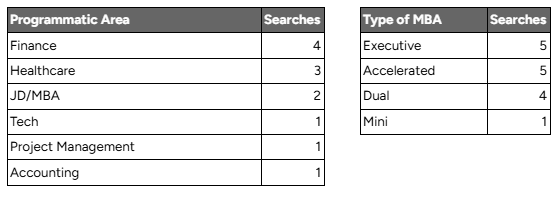
This breakdown shows how Google expands Phrase Match beyond the generic "MBA" umbrella to pull in both program-specific variations (like Finance or Healthcare) and format-based qualifiers (like Executive or Accelerated).
…Do You Even Offer An Executive MBA?
In the same way that Google considers MBA programs at other schools to be a phrase match for "online MBA programs", it also treats "MBA" itself as an umbrella term. Anything that falls under the umbrella of that broader term — whether that's "executive MBA", "healthcare MBA", or "accelerated MBA" — should ultimately be considered fair game for Phrase Match.
This is fine if your institution actually offers those programs. If you don't, it's a problem. You don't want your ads appearing for programs you do not offer. In the same way that you wouldn't advertise your theatre program using engineering keywords, you don't want your ads to be appearing when someone searches for an Executive MBA if that's not something you offer.
You're Paying Google For Clicks From People Interested in Programs You Don't Have
The real risk here isn't just exposure — it's cost. Clicks aren't cheap and the average CPC in the higher education sector has been climbing fast. Wordstream's 2025 benchmark for Education sits at $6.23 — a 42% increase from 2024's $4.39. VisionPoint's own 2025 year-to-date data mirrors Wordstream's findings, with an average Google Search CPC of $6.26.
It's one thing to burn through $6 at a time on irrelevant clicks. The thing is, though, depending on the program you're advertising, the average CPC can be much, much higher.
Again taking a look at our MBA dataset:
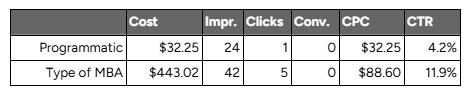
When it came to specific programmatic types of MBAs, 12 search terms resulted in 24 impressions, one click, and no conversions, resulting in an average CPC of $32.25. For different MBA types, the average cost was even more expensive — with 15 search terms, 42 impressions, and five clicks, CPC was $88.60.
A single click at $32.25 stings. But $88.60 for a click that doesn't even convert? That's the kind of inefficiency that can quietly devour your budget.
Wrangling Phrase Match — Proactively & Reactively
One good thing about Google's use of a matching algorithm is that — outside of system updates — those calculations will remain consistent. This means that if Google considers "executive MBA" a phrase match for "MBA" one time, you can count on Google always considering it as a possible phrase match. We've already discussed the risky reality this presents when you're using phrase match, but this predictability also presents you with an opportunity.
Proactive: When setting up ads that use "online MBA programs" as a phrase match keyword, you can anticipate that it will match to search terms like "executive MBA", "accelerated MBA", and the like. If you don't offer these types of programs, you can block them with negative keywords right from the start.
Reactive: Once your campaigns are live, the Search Term Report becomes your new best friend. If you see matches like "finance MBA" and that's not something you offer, you know you're going to need to manage it with negatives going forward — before the algorithm spends more of your budget there.
Qualifiers
We were first introduced to qualifiers at the Exact Match level, where quality and inquiry markers — shorthand cues searchers use to identify a best-fit school — were included when they do not meaningfully change the overall meaning or intent of a search. At the Phrase level, those types of matching qualifiers are expanded ever further, most notably to include financial and difficulty markers.
Financial Markers
For most people, affordability is a hard stop. If someone is searching for an "online MBA program under $20,000" and your program costs $50k, there's a thirty thousand dollar mountain between them and your school. Your program might be excellent — it might even be their dream program — but unless you're clearly explaining how to bridge that financial gap, they're probably not your target audience.
As with most things in life, advertising is about choices. You can choose to take a chance on affordability-related keywords even if your program isn't objectively all that affordable, but you need to do so with your eyes open. For our online MBA program, this means knowing that you're looking at a $50.98 CPC to get that prospective student to your landing page. You might be better off spending that kind of money on better-fit terms.
Difficulty Markers
While I've dubbed this section "difficulty markers", it's really about the search for "easy": easy programs, the easiest programs, easy programs to get into.
I get why people might search for "easy" — life is hard enough and sometimes we just want the smoothest path forward. But this, too, is another one of those advertising choices you have to make. And it's less about whether "easy" applies to your program, and more about whether that's something you want to advertise in the first place.
Same Concepts, Different Thematic Areas
When you zoom out, nearly every Phrase Match variation fits one of two molds: binary-fit categories and contextual-intent categories. With binary categories — like specific types of degrees — you either meet the criteria in question or you don't. Conversely, there's a level of interpretation with contextual-intent categories — like competitor schools or qualifiers for affordability or difficulty. This distinction helps explain why some mismatches are purely factual while others are interpretive. Google isn't matching your keyword to these search terms because the algorithm believes your program is the most affordable or the easiest, but because the search is a "close enough" match.
This is the crux of what it means to "include the meaning" of a keyword — as long as the search includes the fundamental meaning of your keyword, the remainder of the search can be categorically or contextually off-base.
The remaining thematic segments all fall into one of these two categories.
Binary-Fit Categories — States
Similar to what we see with the names of competitor schools, if someone is actively searching for a program in a state other than the one your school is in, you are probably not the best match — even if Phrase Match thinks you are.
The one argument people might make here is that — especially when it comes to online programs — location doesn't (or shouldn't) matter. In reality, however, students are far more likely to select an institution in closer proximity to where they reside. According to 2023 research by The Institute for College Access and Success (TICAS), when it comes to bachelor's and master's students, 47% of those attending a private, not-for-profit university stay within 50 miles of home — and this number jumps to 79% for those attending a public institution.
Given these stats, it's certainly worth considering whether you want to employ some negative keywords to keep your state-bound inquiries limited to the ones in your own backyard.
Contextual-Intent Categories — Time Spans, Specific Populations, and Program Specifics
With time spans, specific populations, and program specifics, your program ultimately either meets the given criteria or it doesn't — there's not a whole lot in between. Your program is either one year long or it isn't. Admission either requires the GMAT or doesn't. Your school is an Ivy or an HBCU, or not.
The good news is that — much the same as with specific degree types — you can employ the same proactive and reactive Phrase Match wrangling tactics to address these binary-fit categories as well. Each time you learn of a new one, it's a relatively simple process to (i) determine whether or not your program fits in that binary categorization; and (ii) add negative keywords as appropriate.
Phrase — The "Yes, But" Match Type
What ties these categories together is the introduction of a wild card factor: a contextual intent or binary-fit qualifier — be that a location, time frame, or descriptor — that changes how searchers are framing their intent. Whether it's "military-friendly," "under 20k," or "accelerated," each addition raises a new question your campaign has to be ready to answer: within the context of this search, does my program still match?
This is the central benefit and challenge of Phrase Match — it multiplies the number of ways your ads can appear, while leaving you to sort out which of those appearances are actually relevant.
Consider how each wild card changes the equation:
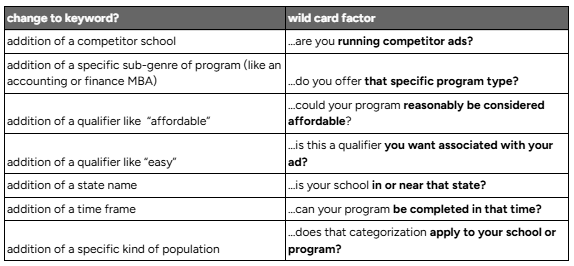
In the end, all of these searches technically "include the meaning" of your original keyword. But if the program you're advertising doesn't actually meet the criteria embedded in the search term — if it's not low cost, or asynchronous, or located in California — there's a disconnect between what the searcher wants and what your ad delivers.
In the next part of this series, we'll loosen the reins even more and examine what happens when Google takes full interpretive control with Broad Match.
Continue reading: Part Four — The Long and Short (Tails) of Broad Match
All examples are drawn from anonymized or representative higher-education campaign data and do not reflect any individual institution’s performance.