This article is part two in a multi-part series and picks up where Demystifying the Algorithm left off. In that piece, we traced how Google's algorithms evolved from counting words to capturing meaning in context. Now it's time to discuss what this means in practice when it comes to your Search ads strategy and execution.
We'll start with the difference between keywords and search terms — a foundational distinction that's crucial to optimizing your Search Ads. After that, we'll take a deeper dive into Exact Match — one of Google's three match type options with a name that, it turns out, can be a little bit misleading.
Keywords vs. Search Terms
When it comes to Search ads, keywords are always taking center stage.
Starting a new campaign? What keywords will you target with it?
Want to optimize performance promoting that key on-campus program? We're probably talking about whether keywords need a refresh.
There's even literally a Keyword Planner section within your Google Ads account.
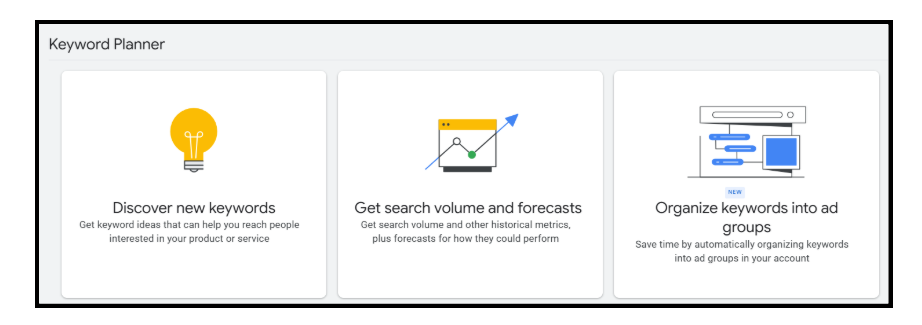
But while we're all keeping busy obsessing over keywords, it's search terms that are really the ones behind the scenes and running the show.
First, Some Definitions
So, what's the difference between a keyword and a search term?
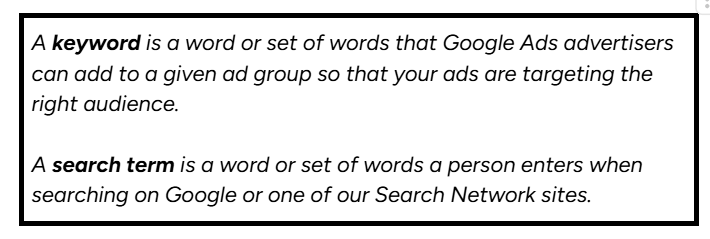
What does this mean for you and your search campaigns? Essentially, it goes like this:
- Keywords are what you're telling Google you'd like to target;
- Search terms are the words/phrases Google ultimately decides have the same meaning (or ✨vibes✨) as the keyword you indicated you were targeting.
When it comes to your campaigns, keywords are essentially the bucket that holds all the different searches someone could make that will result in Google potentially showing your ad.
How big is that bucket? Well, that depends on your match type.
Match Types
Google offers three types of matching: broad, phrase, and exact. At a high level:
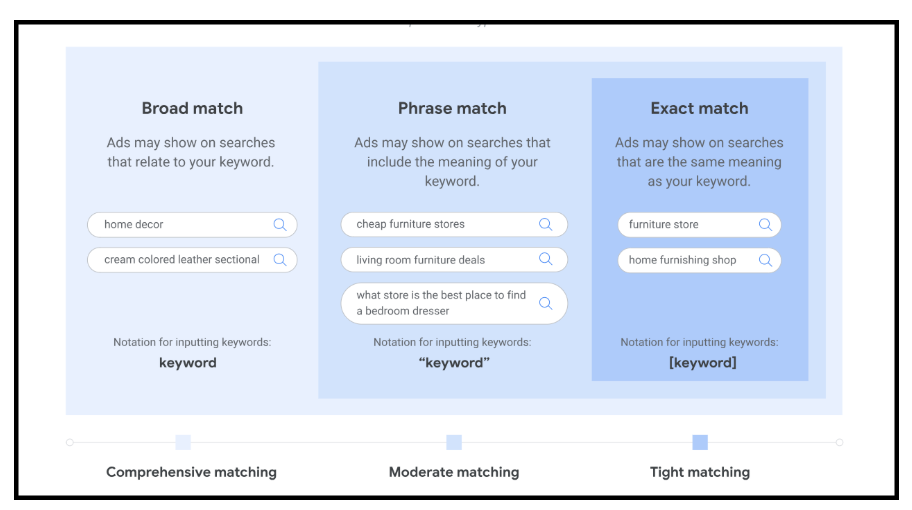
As with most things in life, there's how we define something and then there's what happens in practice. With this in mind, let's take some time to unpack how exact match keywords connect to actual search terms.
Exact Match
The most important thing to note with exact match is that Google stipulates ads may show on searches with the same meaning — not words. In this sense, calling it "exact" is a misnomer; Google's description of this type of matching as "tight" is in fact a far more accurate reflection of what happens in practice.
Speaking of what happens in practice, let's take a look at some actual data so we can better understand what happens with exact match keywords and the search terms they align with in the wild. Let's check out some results from one of our clients for [online mba programs], taken over a three-month period.
In total, our client's keyword matched to 35 search terms. Of those:
- 34 contained the word "online";
- 33 contained "mba";
- 32 contained both "online" and "mba";
- and 24 contained all three — "online", "mba", and "program"
All 24 of the search terms that contained all three words from the original keyword had a total of five words or less. The vast majority (84% — 16 of the remaining 19 search terms) were four words long, while the remaining three were five words long.
Notably, for 16 of the 19 search terms with 4+ words, the additional word was a qualifier or descriptor at the front of the search term:
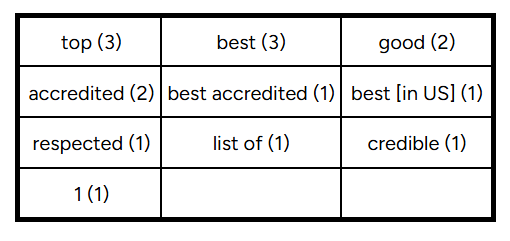
These inclusions provide some very important insights into the types of descriptive words and/or qualifying words Google will allow within its exact match framework. These words are all examples of quality and inquiry markers — shorthand cues searchers use when they're trying to identify a best-fit school or program. They add a measure of context to the search, but their inclusion as exact matches shows that the Google algorithm has been trained to consider these types of quality markers to be irrelevant to changing the overall meaning or intent of a search.
In the remaining three search terms with 4+ words, an additional qualifying word has again been added, but this time as the second word in the search:

These examples show where the additional word does not materially change the context of the search. "MBA degree" is redundant (an MBA is, by definition, a degree). Likewise, "business MBA" repeats what the acronym already conveys. "MBA certificate" is trickier — one could argue it shifts intent, but in reality an MBA is a degree, not a certificate (ie. if you want an MBA, you're going to by definition, have to get a degree). In all three cases, the added word doesn't alter the searcher's intent, so Google treats them as exact matches.
Similar to the examples above, the 11 search terms that did not include the word "programs" reveal a lot about the impact this qualifying word has on the overall context of a search.
First, we have two-word search terms — either mba online or online mba. Essentially, the fact that a person is looking for a "program" is inferred by the algorithm based on the inclusion of the words "MBA" and "online". Accordingly, the absence of the word "program" does not impact the meaning or intent behind the search.
Then we have search terms that are 3+ words in length:
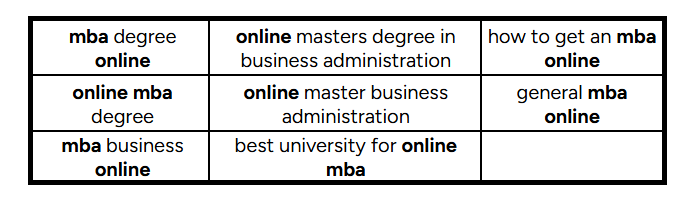
Here we see a ton of overlap with the quality markers and words that do not materially change the context of a search we've previously outlined. "Degree" and "business" are redundant; "best" is a quality marker; "how to" and "general" are inquiry markers; and anything related to a "master(s) (in) business administration" is just the acronym MBA fully spelled out.
The final search term included as an exact match — "at home mba" — is perhaps the most interesting interpretation of an exact match. Effectively, the inference has been made that "at home" is the equivalent to "online". Ultimately, the most important insight we gain here is that, according to Google, when we're discussing online MBA programs, "at home" is considered to have the same meaning as "online". Because all of Google's matching is done via an algorithm, this interpretation of exact will always be true — ie. unless we specifically tell Google not to (via negative keywording), matching our [online mba programs] keyword to "at home mba" is always on the table.
Together, these examples illustrate just how flexible Google’s definition of “exact” really is.
Exact…ish Match
Where intent matters more than literal wording.
The goal of Google's Exact Match isn't to match identical strings of text. Rather, it's all about preserving intent. When Google's algorithm believes the variation between search term and keyword ultimately maintains the overall meaning of that keyword, the two will be matched up — even if that match is not truly exact. As an advertiser, this means you can't assume your "exact" keyword will only serve on the words you typed in.
If you're running Google exact match keywords, you can reliably believe the following situations will be deemed "close enough" and included as potential search matches:
- The removal of words that are not required to understand the keyword's context;
- The addition of quality markers;
- The addition of inquiry markers;
- The addition of words that do not materially change a search's context.
In the next part of this series, we'll begin to unpack how these guardrails loosen even further with Phrase Match.
Continue reading: Part Three — Widening the Net With Phrase Match
All examples are drawn from anonymized or representative higher-education campaign data and do not reflect any individual institution’s performance.