This is part four of a multi-part series. If you want to read this series in order, you can start with Part One: Demystifying the Algorithm, Part Two: From Keywords to Search Terms, or Part Three: Widening the Net With Phrase Match. Otherwise, this article assumes a basic understanding of the machine learning algorithm hiding behind the Google Search curtain, the difference between a keyword and a search term, and how Exact and Phrase Matching with Google works.
TLDR: Broad Match dramatically expands the number of queries your ads can appear on - not just by volume, but by semantic proximity.
While most of those matches look reasonable when aggregated at the campaign or keyword level, analysis at the search-term level reveals inflated CPCs and wasted spend at both the short and long tails. Understanding how Broad Match interacts with Google’s ANN system is key to evaluating its real trade-offs.
Broad Match
Unlike the explanations for Exact and Phrase match, there is a notable absence of the word “meaning” in the description Google provides for Broad match. Instead, Google indicates that ads may show on searches that “relate to your keyword”.
Once again, let’s revisit how Google explains their three match types:
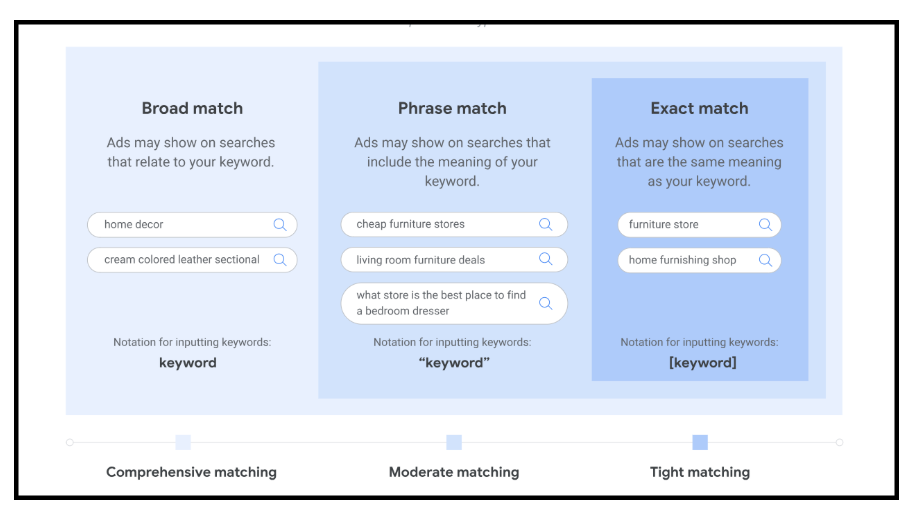
The path from Exact Match to Phrase Match to Broad Match keywords goes from "same meaning" to "meaning" to "relate(d)" - and in practice, this version of "related" can stretch much farther than most advertisers might expect.
This distinction matters not just because the match types differ, but because most Google Ads reporting still evaluates performance at the campaign or keyword level - the layers where Broad Match performance is aggregated, and where its inefficiencies are easiest to miss.
How Broad Match Shows Up in the Data
We’ve previously taken a look at our data regarding matching search terms for the keyword “online MBA programs” at both the Exact and Phrase levels so it only makes sense to continue on down to Broad.
With Exact Match, our client’s keyword aligned with 35 search terms. This expanded to 136 at the Phrase Match level. Unsurprisingly, the jump from Phrase to Broad resulted in another increase, but just how many more might raise some eyebrows.
There were 3,062.
While Google ultimately chose to be fancy and describe this matching style “comprehensive”, we might also just describe it as, well, broad. Moving from Exact to Phrase expanded matches ~4×; moving from Phrase to Broad expanded them more than 22× - a shift Google describes as “comprehensive”...and most advertisers experience as overwhelming.
The good news is that even broad matching has trends we can unpack, understand, and work with. Let’s take a deeper look at what we can learn from our actual broad matches.
The Long and the Short of Things
Our "online MBA programs" keyword is three words long. At both the Exact and Phrase Match levels, our corresponding searches were of a similar length — Exact averaged 3.8 words, while Phrase averaged 4.4. The two also had very similar ranges — from 2–6 words for Exact and 2–7 for Phrase. At an average of 3.7 words, Broad Match maintained a similar average length, but had a much wider range — from one-word searches all the way to 12-word ones.
Search length for all 3,062 terms broke down as follows:
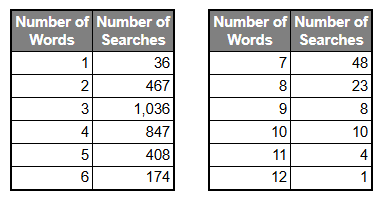
Overall, more than 97% of broad match keywords fall into the same length range as exact and phrase. When it comes to spend, however, search term lengths outside this range account for more than triple their expected proportion (1 word — 7.52%; 8–12 words — 2.23%, for a total proportion of spend of 9.75%).
And when it comes to long-tail keywords — the ones with more than eight words — not only did they generate no conversions, they did so with an average CPC of $68.04 — nearly three times higher than the overall broad match CPC of $22.70.
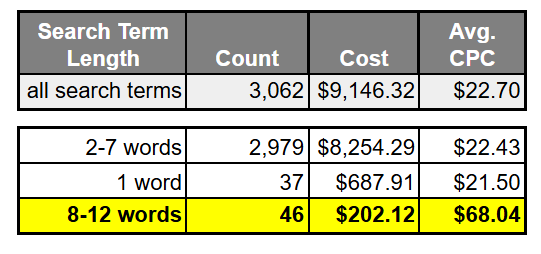
There's a longstanding belief in Google Search circles that targeting long-tail keywords can be advantageous because they are most commonly lower competition, and accordingly, come with a cheaper CPC. In the era of Broad Match, however, this recommendation no longer holds true. And in order to better understand why, we again need to turn to the algorithm that powers Google's system, and more specifically, to its Approximate Nearest Neighbors (ANN) engine.
A Short Segue To Talk ANN
We've previously discussed how advances in machine learning have allowed Google to move beyond literal text matching and toward the interpretation of context and meaning. This means that matching is no longer about exact words overlapping; it's about semantic proximity — how closely two ideas live in meaning-space.
Think of Google's search data as a map full of neighborhoods. Over decades of searches, Google has plotted billions of data points, and each of those is like coordinates on a map. Terms that appear in similar contexts — like "MBA program", "business school", and "graduate management degree" — share similar coordinates, so they end up residing in the same neighborhood.
The neighborhoods used for broad matching? They're massive. We're not talking quiet suburban blocks; these are dense downtown cores — towering skyscrapers packed with terms that are only loosely related. This is why individual words like "college" and "university", as well as questions like "can I get an mba with a biology degree" also live in the "MBA program" neighborhood.
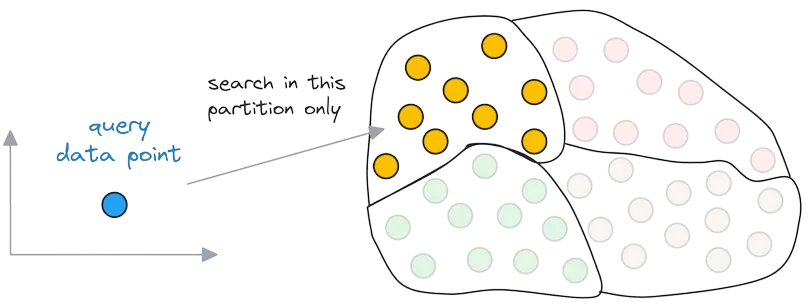
Image courtesy of dailydoseofds.com
When a new search comes in, Google's algorithm doesn't search the entire city. Instead, it has been trained to head straight to the neighborhood that's semantically closest to that query. When it gets there, it gathers up that search term's nearest neighbors — the terms ranked as most similar in meaning — and uses these as the pool of "close enough" matches that enter the search auction.
How ANN Creates Competition
The important takeaway here isn’t that ANN is flawed — it’s that it changes the economics of keywords in ways most advertisers never explicitly evaluate.
Broad Match uses approximate nearest neighbors to expand the pool of “close enough” to your keyword. But Broad Match isn’t just expanding your matches – it’s also expanding those of your competitors who use keywords that also match to these “close enough” terms.
This means that the number of potential matches entering the auction for a term like "can I get an mba with a biology degree" has multiplied in a way that directly corresponds with ANN. If multiple advertisers are now bidding on different phrases within the same broad match neighborhood, Google can effectively create competition where none existed before.
And it's this newly created competition that drives CPC up — even if no one is explicitly bidding on the search term itself.

Ultimately, this is how a long, specific search query like “can I get an mba with a biology degree” ends up being classified as a “medium” competition keyword with top-of-page estimates between $11.91 and $33.20 – even when the search volume is tiny and intent is highly specific.
When it comes to segments and themes in Broad matching, the previously-low-competition queries appearing at both the short- and long-tail ends of the search spectrum prove to be incredibly informative. Let’s dig back into our “online MBA programs” data.
The Short: Single-Word Searches
It only seems fitting that the 36 single-word broad match queries can be segmented into broad themes — three in total: MBA-related (8); degree/course-related (9); and school-related (18).
MBA: These include "MBA" itself, along with more specific types like "EMBA", "MBAI", and broader variants like "MSBA". They're the most relevant from a semantic perspective, but also the lowest in intent.
Degree/Course: The relationship between these terms and the keyword makes sense only in hindsight. They are words you might associate with an MBA — "degree(s)", "graduate", or "masters" — but they're far too broad to select as keywords intentionally. Similarly, alternative course offerings like "harvardx", "ecornell", or "altmba" share conceptual overlap with our keyword, but are unlikely to yield meaningful engagement.
School-Related: The most relevant terms here were those associated with other colleges' business schools — "fuqua" (Duke), "wharton" (UPenn), "hbs" (Harvard), and even "CEIPA" (a Colombian business school affiliated with ASU). The connection here is essentially "when people search for business schools, it's often because they want to do an MBA."
More than half of these school-related queries were names, short forms, or acronyms for other institutions. A few were relevant due to geographic proximity, but the majority were minimally relevant — including for-profit colleges, international universities, and even a for-profit high school.
Finally, there were the most generic of higher-ed descriptors — "college(s)", "university", and "universidad" (the Spanish word for university).
Pulling it All Together:
While each of these search terms can be linked to "online MBA programs" in hindsight, none are words an advertiser would have willingly chosen to bid on. They all live in the same semantic neighborhood, but certainly not the same strategic one. With Broad Match, semantics win out over strategy — and it's how you end up serving ads on searches like "college" or "imba" (the International Mountain Biking Association — coincidentally acronymed like a business degree).
The Long (Tail)
What about those 8+ word queries generating no conversions with oddly expensive CPCs? These are the kind of searches that appear to be hyper-specific but ultimately result in little to no performance traction.
Two themes dominated this tail: competitor programs (yes, again) and informational questions.
Programs at Another School: 17% of long-tail searches were full program names tied to other institutions — queries like "university of tennessee online masters supply chain management", "w p carey school of business at arizona state university", and "university new york of business and technologies unybt", a term that actually resulted in a $173.84 click. These hyper-specific competitor references drive up costs because Google's algorithm views them as high-intent. And they are — but for someone else's brand.
Questions (That Are Better Answered With Organic Search): Nearly three quarters of all long-tail searches were questions. The majority of these questions began with "how" ("how long does it take to get a mba", "how hard is it to get a mba"), while three other words — "can" ("can i get an mba with a biology degree"), "does" ("does it matter where you get an mba"), and "is" ("is an mba still worth it in 2025") framed the remainder. These queries represent classic top-of-funnel research moments, evidenced by their low engagement rate with only two clicks across 77 impressions.
Of the two clicks received, one was relatively cheap ($4.78 for "how many years does it take to get an mba") while the other was 5x more expensive ($25.50 for "how long do you have to go to school for business management") — even though both queries effectively ask the same thing. This discrepancy evidences the reality of long-tail CPC fluctuation; it's all about who else happens to be broad match bidding at that moment in time, not the value of the query itself.
These aren't the searches you want to be paying for. Long-tail questions are best handled through organic content — whether that's FAQs, blogs, or program pages — that provide answers to these questions, educate, and build awareness without eroding ad spend.
Wrapping Things Up — Short and Sweet
Overall, the long tail doesn't introduce new behaviors so much as it amplifies the ones we've already seen. Taken together, the short and long ends of Broad Match show the same truth from opposite sides: the algorithm is constantly searching for semantic similarity. As advertisers, it's up to us to decide which similarities are actually worth paying for.
At both ends of the spectrum, Broad Match uses those semantic associations to connect what were once "cheap," low-competition terms (like MBA) with high-intent, high-CPC phrases such as online MBA programs. When advertisers add those richer phrases as broad keywords, Google's model begins pulling those simple-but-still-neighbors terms into the same auction pool.
The result is predictable: denser auctions for queries Google has broad matched to multiple advertisers' keywords, which ultimately results in a higher average CPC for what used to be inexpensive, top-of-funnel terms.
Broad Match, in other words, isn't just expanding your reach — it's expanding the market. It's a predictable outcome, but it's expensive. You spend more than expected, and much of that spend goes toward lower-intent searches that your ads were never explicitly built for.
That's where this evolution lands us: a system that interprets meaning beautifully but manages intent imperfectly. The goal isn't to reject Broad Match altogether — it's to recognize what it's doing, measure the trade-offs, and design your campaigns accordingly.
All examples are drawn from anonymized or representative higher-education campaign data and do not reflect any individual institution’s performance.