Originally published by VisionPoint Marketing, July 16, 2025. This is part two of a two-part series on word sense in enrollment emails. Part one looks at "apply."
In part one of this series, I introduced the concept of word sense — the idea that the meaning of a word isn't fixed, but shifts depending on the context in which it's used. I explored that through "apply," a word that turns out to do genuinely different things depending on what surrounds it: sometimes emotional, sometimes transactional, sometimes written to the wrong audience entirely.
The word "opportunity" has a very different story.
A Quick Note on the Data
This analysis draws from a corpus of 3,116 RFI emails collected from 100 U.S. colleges between August 2024 and April 2025. Each email was categorized, cleaned, and prepared for linguistic analysis. The top 20 most frequently used words across the full dataset are covered in part one — this piece picks up from there and focuses specifically on how "opportunity" is being used.
"Opportunity" in Context
While "opportunity" appeared far less frequently than "apply," it was still a common word, appearing in 536 different emails. Based on its frequency alone, I expected it to appear in a wide range of contexts — attached to academic outcomes, scholarship possibilities, career trajectories, personal growth. What I actually found was considerably more uniform.
Your Opportunity

This first email leverages the word "opportunity" in relation to what is provided via an invitation to campus. It is used to help explain what the reader will gain by taking the college up on this invite — in this case, a chance to learn about the different programs offered at the college.
An Exciting Opportunity
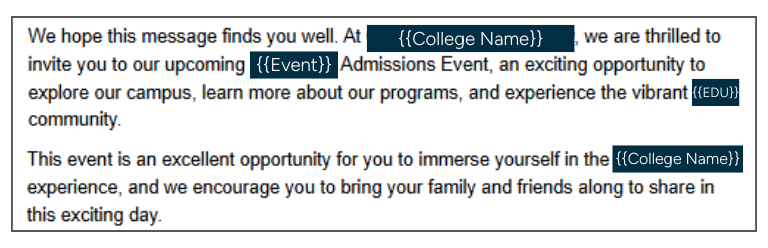
The second example is also an invitation to campus — this time in the form of a named admissions event. There are two relatively similar uses of the word, where both again aim to explain what the reader will gain by accepting the invitation — in this case, the opportunity to explore campus and the opportunity to be immersed in the school "experience."
In both uses here, a superlative has been appended to the word — this is not just an opportunity, but an exciting and an excellent one. The addition of these superlatives serves not only to amplify the importance of the opportunity being offered, but also adds a measure of context to the type of opportunity on offer.
The Opportunity
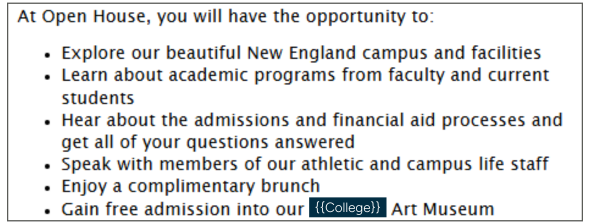
This is another example where the opportunity on offer is an invitation to attend an event on campus. Usage here does, however, differ slightly from the two examples above — this is not your opportunity or an exciting opportunity; rather, in this instance the "you" appears four words ahead of opportunity. This is interesting because the email is still personalized, but the distance between you and opportunity changes how that personalization is presented to the reader.
This is the first example that leverages a list structure for articulating the opportunity(ies) on offer, which ultimately results in a more robust explanation of what there is to be gained by accepting the invitation on offer.
The Opportunity (of a Lifetime)
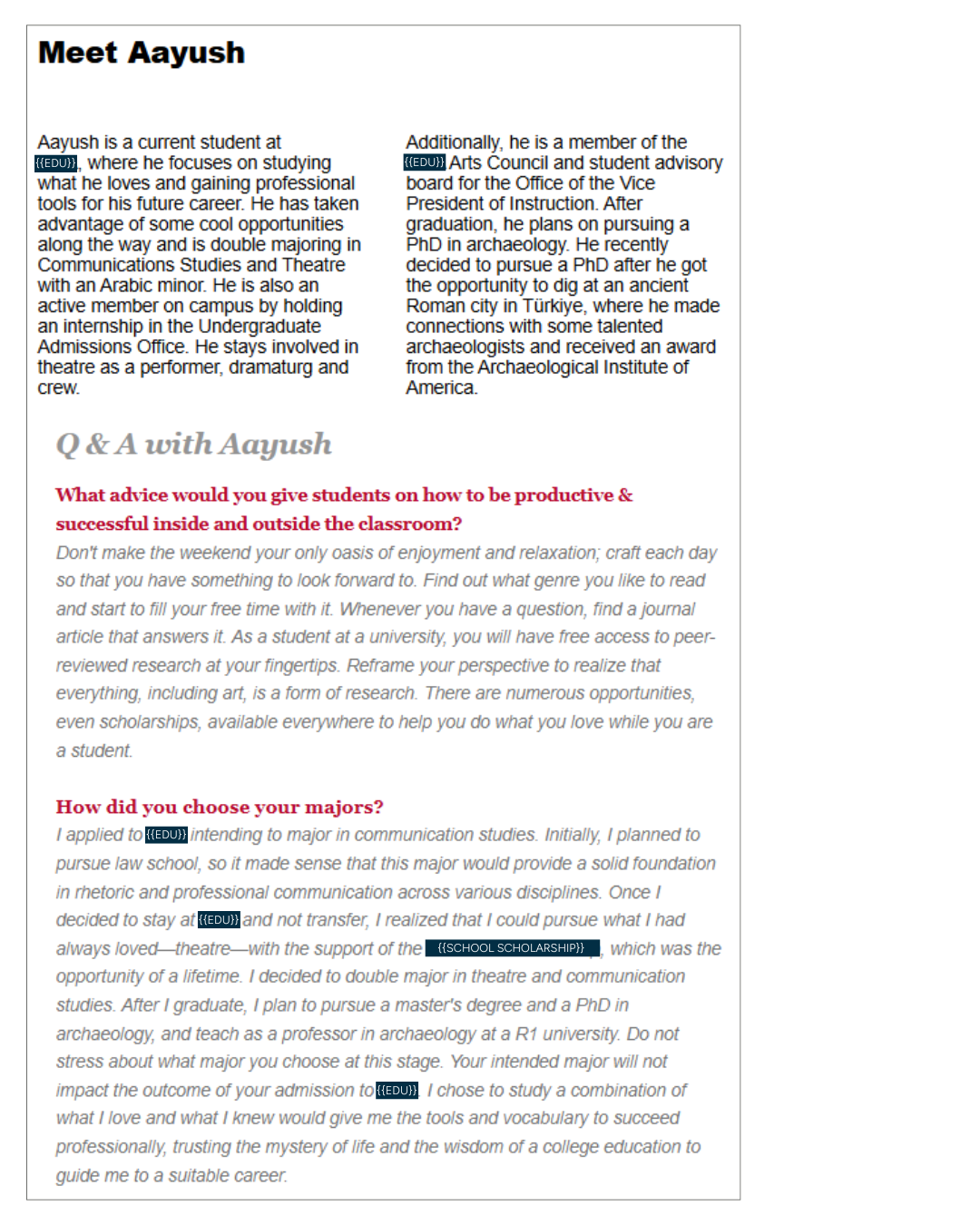
This example finally provided a use of the word that was not associated with an invitation. Instead, the two uses of "opportunity" from this email relate to a profile/story about a current student. The first use is similar in meaning to the invite examples above — there was something to be gained. Instead of referencing the specifics of what's available by attending an on-campus event, however, this usage discusses the specifics of what the student was able to do because of this particular opportunity he was given.
The second use of the word here is arguably the most unique from these examples, and the first where what's being described is not the opportunity to do something (i.e., "opportunity" precedes describing an outcome) but rather how something one had the chance to do can ultimately be regarded as having been an opportunity. What's ultimately described is still something that was gained, but the order of operations has been reversed.
A Unique Opportunity
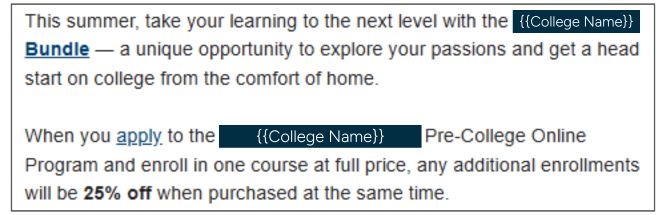
Transparently, I passed over eight more examples where "opportunity" referenced an invite to attend an on-campus event while trying to find another example that didn't leverage the word in that particular context. Nonetheless, the usage here is still relatively similar; instead of an on-campus event, it's a pre-college online program that's on offer. If you take advantage of this opportunity, you stand to gain a head start on college — with the value-add of doing so from the comfort of your home. This is another example where a superlative is appended to "opportunity" (this time the word "unique").
Opportunity for Context
While I had originally expected the word "opportunity" to appear in a wider range of contexts, I was surprised to discover that its use was by far most commonly tied to campus visits and events. This recurring usage narrows the semantic range of the word — while it still carries aspirational tones, its purpose in these examples is more logistical and recruitment driven rather than transformational.
Across these examples, "opportunity" consistently serves as a framing device that positions institutional invitations as valuable and worth seizing. When paired with superlatives like "exciting," "excellent," and "unique," the word becomes even more of a strategic tool — not one that describes the actual college experience, but rather one that suggests the reader will uncover that for themselves if they attend the event. In this sense, "opportunity" functions less as a promise from the college that it can provide the reader with a particular gain and more as a dangling carrot of potential to be gained by prospective students who take that next step.
In contrast, the one example with a student narrative demonstrated a different, more reflective use of the word. Referring to academic experiences as "the opportunity of a lifetime" positioned the experience as a meaningful personal achievement and as a retrospective endorsement rather than a future-oriented incentive.
Even though use of the word "opportunity" was largely consistent in the emails, its meaning was shaped by sentence structure, tone, and rhetorical placement. Its positioning before a list of campus activities, modified by emotional language, or embedded in storytelling ultimately served to alter meaning subtly. In this sense, the word is not just a static, feel-good term, but is indeed a flexible rhetorical device that gains meaning from the language that surrounds it.
So What? Why Words — and Context — Matter
It's really easy to take words for granted. It's even easier to overlook the subtlety related to context — that it's not just what words we use but also how we use them.
In enrollment communications, words don't just convey information; they shape perceptions, create expectations, and build emotional connections. The same word can invite action, inspire belonging, or be used to simply list out requirements — all dependent on the context in which that word is used.
When it comes to our communications with prospective students, the words "apply" and "opportunity" get used with great frequency. With that frequency comes a measure of comfort; we begin to believe we know what will be conveyed when we see these words. But what I hope these examples have shown is just how much meaning can shift depending on the context. There's more to effective communication than just choosing popular, positive, or buzzy words; we need to intentionally craft messages where the words we use align with the emotions, motivations, and stages of the student journey we are hoping to address.
Recognizing the nuanced ways words work in context helps enrollment teams go beyond generic messaging and deliver communications that resonate personally and authentically. It's the difference between an email that simply informs and one that truly engages — and ultimately, between outreach that fades into the background and outreach that actually moves students forward.