Originally published by VisionPoint Marketing, July 16, 2025. This is part one of a two-part series on word sense in enrollment emails. Part two looks at "opportunity."
It's not just what you say or how often you say it. Where, when, and how you communicate with prospective students can generate valuable insights into the overall enrollment process.
Words and Their Meaning
The ultimate meaning of a word can vary based on how we use it. In linguistics, this is referred to as word sense — the different meanings a word can have in different contexts. This concept is foundational to understanding language as more than just words; it's crucial to understand that how we put words together matters.
With this in mind, I wanted to explore not just which words appear with greater frequency in request for information (RFI) emails, but how those words are being used. I wanted to approach this exploration while considering the words through two lenses:
- How I expect the words in question to be used (based on what I know or believe about the subject matter)
- How those keywords were actually used in different emails
The Data
In August 2024, I filled out RFI forms for prospective undergraduate students at 100 U.S. colleges.
In return I received 3,116 emails.
I categorized them based on the school they were sent from and whether they arrived as an inbox email or as spam. Then for further analysis, I exported all the emails (and the back-end data that goes with them) for further data manipulation. As with most data projects, what followed was a tedious data cleaning and validation process that eventually resulted in a clean dataset where the content of every email was ready to be used as the building blocks of analysis.
In technical terms, we turned a large collection of texts — the emails — into a corpus: a collection of texts that serve as the foundation for linguistic analysis.
What can you do with a corpus? Well, to start, you can look at the words that occur most frequently in those texts. For our RFI emails, the top 20 looked like this:
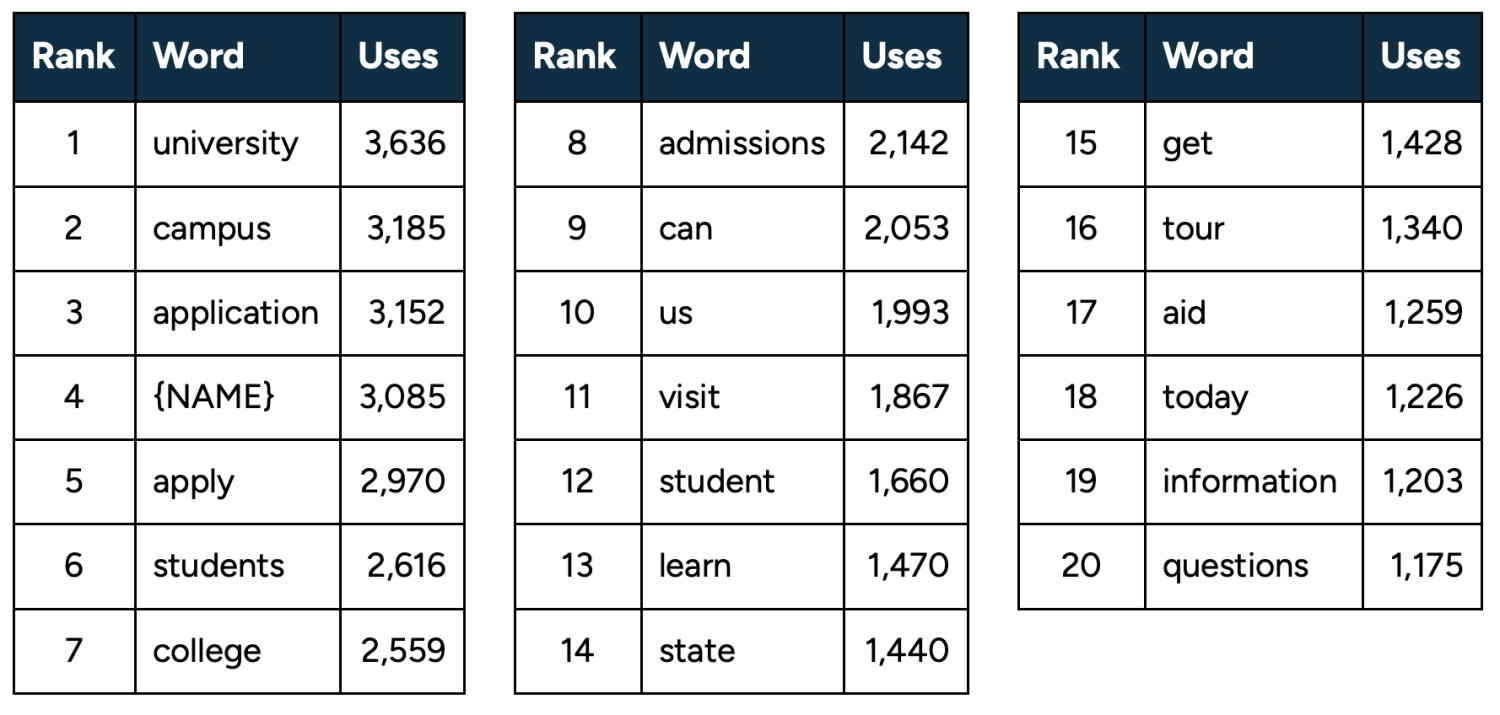
This information on its own can be valuable — certainly, it answers questions related to what it is we are saying most frequently when we reach out to students. But it can also serve as a starting point and a guide to other questions we may want to ask about this data.
And this context around the data is what (finally) brings us to today's analysis — namely, we're going to use the information above to help ask and answer an important question that goes beyond the words we use in RFI emails — we want to know more about how we use them.
"Apply" in Context
As an integral step in the pathway between inquiry and enrollment, it is not particularly surprising that the word "apply" appears with high frequency in RFI emails. The fifth-most used word overall, "apply" appeared in just over half of all emails (1,578 of 3,116) and was used a total of 2,970 times. The related term "application" was used even more frequently (3,152 uses — third overall), while the oft-related term "admissions" ranked eighth with 2,142 uses.
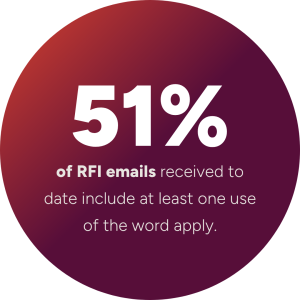
To better understand the context of the word's usage, I used a random number generator to help select five random emails from that pool.
Apply Above
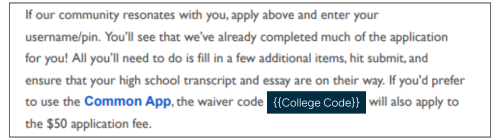
This first example is a fantastic way to kick this off, as it contains two uses of the word with very different meanings. In the first, it's a verb directed at the reader and refers to applying to college. Specifically, the school frames the decision to apply as one tied to feeling aligned to the community the school offers; they are attaching an emotional connection to the reader's decision to apply.
In the second instance, "apply" is no longer a reference to the reader's application to the institution, but rather its use is procedural; if the reader uses the code when filling out their application, the school will "apply" a $50 waiver of the application fee.
Within this first email, we already see a poignant example of how the meaning of the same word can be completely different when applied in different contexts.
Apply Now
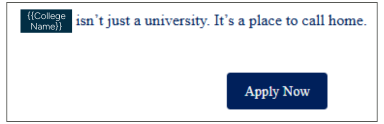
This next use of the word "apply" is included in a directive that both encourages the reader to apply and aims to introduce time-sensitivity by encouraging that application to be submitted now.
Similar to the example above, the statements prior to the use of "apply" again aim to foster emotional connection by describing the college as a place to call home. In this particular usage, however, there's no if this/then that set up; rather, it's set up as more of a statement of fact (this isn't a university; it's a place to call home) followed by encouragement to apply.
Apply Today
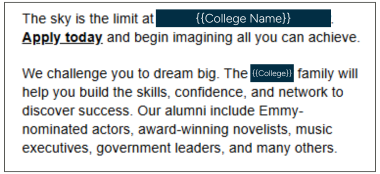
This usage of "apply" demonstrates another variation on the theme of emotional connection. Like the second example, this is again not an if this/then that relationship that's being built; but unlike the second example, this one is not a loosely disconnected statement meant to encourage the reader to make inferences about calling a place home and wanting to apply to be there. Rather, this usage specifies what submitting an application will allow the reader to do — imagining all they can achieve at this college — followed up by assertions and superlatives related to how the school will help them do so.
You Can Apply
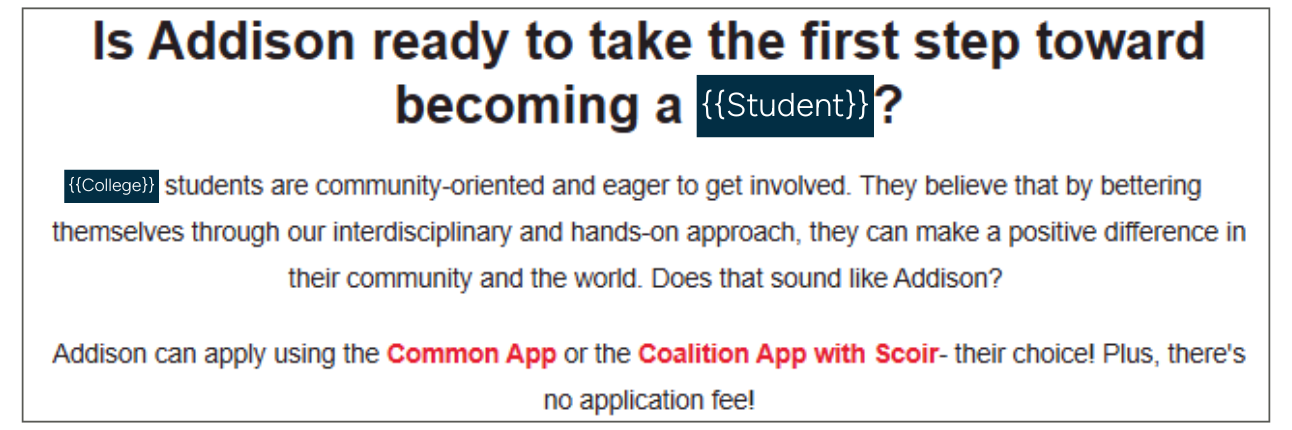
Notably, unlike the other examples, this one is not written to the reader; instead, it is written to a third party that would encourage someone else to apply.
As another layer of context outside of how this particular example is written — when I submitted RFI forms to the different schools, I did not ask to be signed up for any parent/influencer audience emails. Given this, if I had submitted these forms because I was looking to attend college (not just assess college prospect emails), the third-person voice in this example would likely be a bit jarring.
This usage does, however, continue to leverage an emotional connection to community and to aligning the values of the prospective applicant with the values the college believes to reflect and espouse.
One Email; Six Applies

This last example is an explosion of "apply" and features six different uses. Unlike the other examples, this one does not aim to make an emotional connection; rather, each use of the word refers more to procedural undertakings — applying before a deadline, applying to the institution, applying for priority housing. And if you have questions about the application process? There's a procedure for that, too.
Apply-ing Context
While there is a great deal of similarity in the meaning of the word "apply" across these examples, when there are shifts, they are largely dependent on grammatical use and rhetorical purpose. Most commonly, "apply" was used as a direct call to action; one that encourages prospective students to submit their application to that specific college. There are, however, variations in both the tone and the function of that call to action; some uses are framed emotionally, while others are more transactional or deadline-driven. The first example also captures a second application of "apply" — the process of applying something (like a waiver to a fee) vs. the process of the reader applying to something. Ultimately, this reflects two different meanings of this one word.
Even when considering examples with some measure of similarity in their use of the word "apply," meaning and intent is ultimately shaped by the phrases that surround it. Some uses emphasize emotional connection, others logistics or the fostering of urgency. Many leverage personalization, while the "You Can Apply" example — with its third-person voice — ultimately has a more de-personalized voice. Taken together, these examples show that while "apply" might appear frequently and seem to have a straightforward meaning on the surface, its communicative purpose is in fact highly dependent on context.
"Apply" is the word that shifts. In part two, I examined "opportunity" — and found almost the opposite problem.