The companion to the Reach story — but where that one ends on a conference stage, this one ends in a product. It traces a single idea from a small course proof-of-concept to the framework I now offer.
① The proof — can this even be done?
Before the framework, a proof of concept. I started with a smaller, testable question — can you predict whether a college's recruitment email lands in the inbox or the spam folder? — and built an NLP and random-forest classifier on a corpus of real emails. It worked, and it taught me two things: that deliverability is driven more by how a message is sent than what it says, and — more importantly — that recruitment email could be treated as structured data at all. That was the opening the whole line of work needed.
② The method — reading email at scale
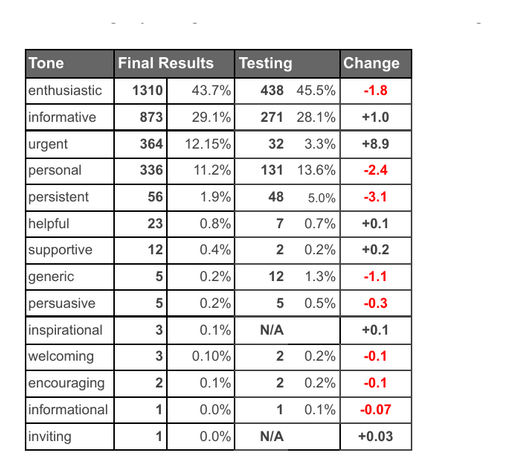
Then, the real engine. I submitted RFI forms to 100 US colleges under a single student persona, collected 3,000+ emails over ten months, and built a two-prompt generative-AI pipeline to classify each message's topic and tone. This is the leap from "can I model one signal" to "can I read what thousands of emails, together, are actually saying" — and the finding that colleges lead overwhelmingly with enthusiasm over substance is what gave the framework something worth benchmarking.
③ The framework — Prospect Communication Intelligence
That method became a product. Prospect Communication Intelligence is a structured, benchmark-based framework that evaluates an institution's prospect email not on opens and clicks, but on what it says, how it's sequenced, and how it compares to the market — across five dimensions, from scorecard and market comparison to messaging focus and narrative sequencing. It's the research, productized into something a school can actually engage.
④ The deliverable — 2026 Prospect Email Benchmarks
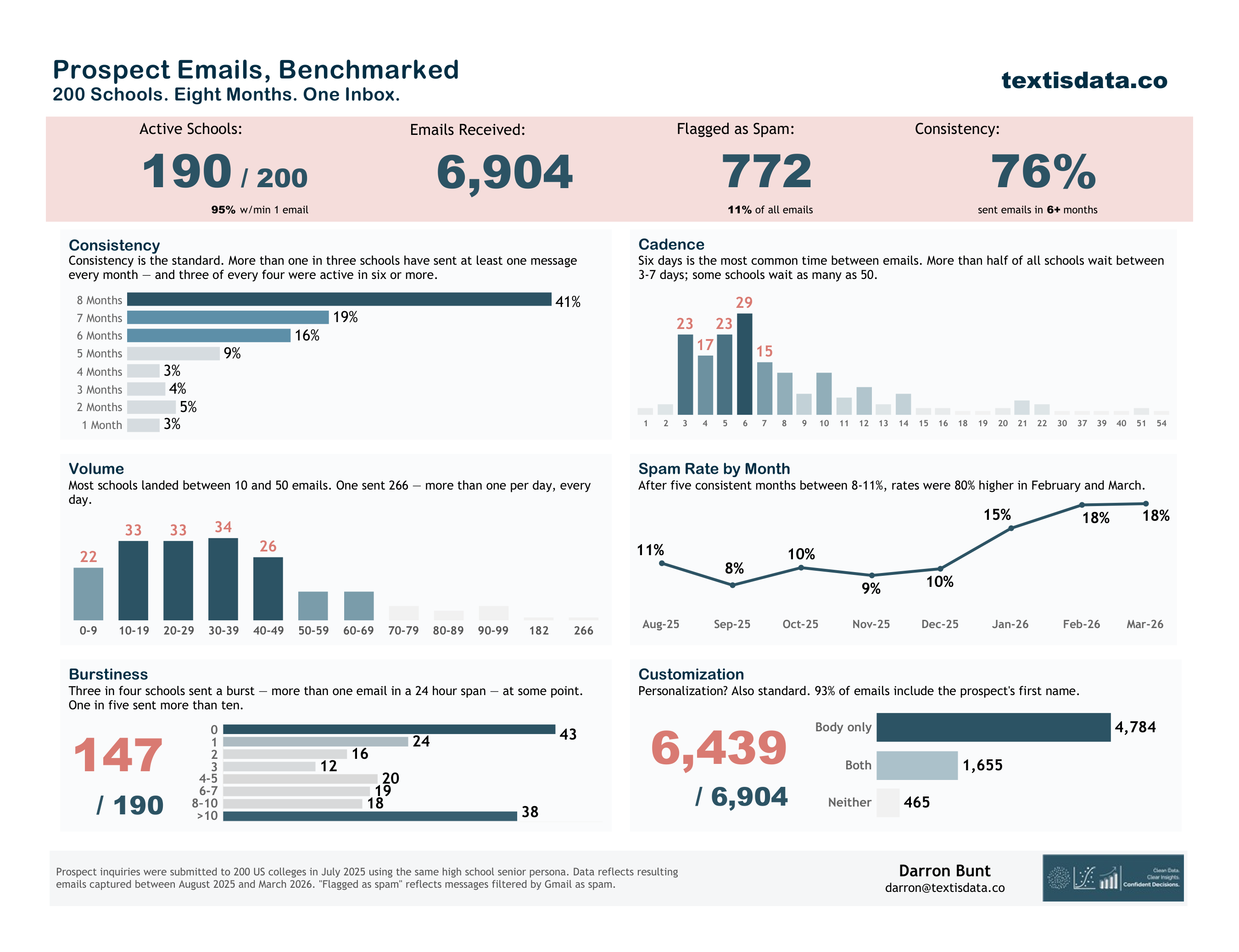
And the reference point it's measured against: the 2026 Prospect Email Benchmarks — a public benchmark of the higher-ed prospect email landscape, built from thousands of emails across hundreds of institutions. Every institutional snapshot is scored against it.
This is the full distance from a course requirement to a commercial offering — the same research instinct as the Reach story, carried one step further into a product I stand behind.